
Phyllanthus emblica
Jump to navigationJump to search
| Phyllanthus emblica | |
|---|---|
 |
|
| Plant | |
 |
|
| Fruit | |
Scientific classification |
|
| Kingdom: | Plantae |
| Clade: | Tracheophytes |
| Clade: | Angiosperms |
| Clade: | Eudicots |
| Clade: | Rosids |
| Order: | Malpighiales |
| Family: | Phyllanthaceae |
| Genus: | Phyllanthus |
| Species: |
P. emblica
|
| Binomial name | |
| Phyllanthus emblica | |
| Synonyms[3] | |
|
|
Phyllanthus emblica, also known as emblic,[2][4] emblic myrobalan,[2] myrobalan,[4] Indian gooseberry,[2][4] Malacca tree,[4] or amla,[4] from the Sanskrit amalaki, is a deciduous tree of the family Phyllanthaceae.
_at_Jayanti,_Duars,_West_Bengal_W_Picture_045.jpg)
Budding and flowers
Plant morphology and harvesting[edit]
The tree is small to medium in size, reaching 1–8 m (3 ft 3 in – 26 ft 3 in) in height. The branchlets are not glabrous or finely pubescent, 10–20 cm (3.9–7.9 in) long, usually deciduous; the leaves are simple, subsessile and closely set along branchlets, light green, resembling pinnate leaves. The flowers are greenish-yellow. The fruit is nearly spherical, light greenish-yellow, quite smooth and hard on appearance, with six vertical stripes or furrows. The fruit is up to 26 mm (1.0 in) in diameter, and, while the fruit of wild plants weigh approximately 5.5 g (0.19 oz), cultivated fruits average 28.4 g (1.00 oz) to 56 g (2.0 oz)[5]
Ripening in autumn, the berries are harvested by hand after climbing to upper branches bearing the fruits. The taste of Indian emblic is sour, bitter and astringent, and it is quite fibrous.
Buddhist symbolism[edit]
 |
This section needs additional citations for verification. (May 2017)
|
In the Buddhist tradition there are many references to the fruit of the emblic myrobalan. In the Śatapañcāśatka, Buddha’s knowledge is described in a poetic simile: “O Bhagavan, the entire origination of all types of phenomena throughout time is within the range of your mind, like an ambalan fruit in the palm of your hand”[6]
Half an amalaka fruit was the final gift to the Buddhist sangha by the great Indian emperor Ashoka. This is illustrated in the Ashokavadana in the following verses: “A great donor, the lord of men, the eminent Maurya Ashoka, has gone from being lord of Jambudvipa [the continent] to being lord of half a myrobalan” (Strong, 1983, p. 99).[7] In Theravada Buddhism, this plant is said to have been used as the tree for achieving enlightenment, or Bodhi, by the twenty first Buddha, named Phussa Buddha.[8]
Traditional uses[edit]
Culinary use[edit]
The amla fruit is eaten raw or cooked into various dishes, such as dal (a lentil preparation) and amle ka murabbah, a sweet dish made by soaking the berries in sugar syrup until they are candied. It is traditionally consumed after meals.[citation needed]

Indian gooseberry pickle
In the Batak area of Sumatra, Indonesia, the inner bark is used to impart an astringent, bitter taste to the broth of a traditional fish soup known as holat.[9]
Traditional medicine[edit]
In Ayurveda, dried and fresh fruits of the plant are used as a common constituent.[10][11]
Chemical constituents[edit]
These fruits contain high amounts of ascorbic acid (vitamin C),[12] and have a bitter taste that may derive from a high density of ellagitannins,[10] such as emblicanin A (37%), emblicanin B (33%), punigluconin (12%), and pedunculagin (14%).[13] Amla also contains punicafolin and phyllanemblinin A, phyllanemblin other polyphenols, such as flavonoids, kaempferol, ellagic acid, and gallic acid.[10][14]
Gallery[edit]
-

Amla at the top of the Lingaraj temple in Bhubaneswar
-

Hand of a standing Buddha statue holding a myrobalan
-

Seed
-

Fruits
-

Leaves
-
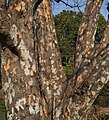
Trunk and main branches, highlighting mottled bark
_-_Oct_2010.jpg)


_new_leaves_at_Jayanti,_Duars,_West_Bengal_W_Picture_039.jpg)

See also[edit]
 |
Wikimedia Commons has media related to Phyllanthus emblica. |
- Emblicanin
- Triphala, an Ayurvedic mixture containing amla
References[edit]
- ^ Roland, C. (2020). “Phyllanthus emblica“. IUCN Red List of Threatened Species. 2020: e.T149444430A149548926. doi:10.2305/IUCN.UK.2020-3.RLTS.T149444430A149548926.en. Retrieved 19 November 2021.
- ^ Jump up to:a b c d “Phyllanthus emblica“. Germplasm Resources Information Network (GRIN). Agricultural Research Service (ARS), United States Department of Agriculture (USDA). Retrieved 2008-03-06.
- ^ “The Plant List: A Working List of All Plant Species”. Retrieved 14 July 2014.
- ^ Jump up to:a b c d e Lim, T.K. (2012). “Phyllanthus emblica“. Edible Medicinal And Non-Medicinal Plants. Springer Netherlands. pp. 258–296. doi:10.1007/978-94-007-4053-2_37. ISBN 9789400740525.
- ^ Huxley. A. The New RHS Dictionary of Gardening. 1992. MacMillan Press 1992 ISBN 0-333-47494-5
- ^ Chen, K. (1952). The Śatapañcāśatka of Mātrceta: Sanskrit Text, Tibetan translation and commentary, and Chinese translation. Edited by D. R. Shackleton Bailey, with an introduction, English translation and notes. Cambridge: The University Press, 1951. xi, 237 p. The Far Eastern Quarterly, 11(3), 408-410. doi:10.2307/2049590
- ^ Strong, J. S. (1983) The Legend of King Ashoka, New York: Princeton University Press
- ^ Buddha: His Life, His Teachings, His Order: Together with the History of the Buddhism, Manmatha Nath Dutt, Society for the resuscitation of Indian literature, 1901, p. 3
- ^ de Clercq, F. S. A. (1909). Nieuw Plantkundig Woordenboek voor Nederlandsch Indië. Amsterdam: J. H. de Bussy. p. 303.
- ^ Jump up to:a b c Dharmananda S (September 2003). “Emblic myrobalans (Amla)”. Institute of Traditional Medicine.
- ^ Indian Ministry of Health and Family Planning. The Ayurvedic Formulary of India. Part I. 1st ed. Delhi, 1978.
- ^ Tarwadi K, Agte V (Aug 2007). “Antioxidant and micronutrient potential of common fruits available in the Indian subcontinent”. Int J Food Sci Nutr. 58 (5): 341–9. doi:10.1080/09637480701243905. PMID 17558726. S2CID 7663752.
- ^ Bhattacharya, A.; Chatterjee, A.; Ghosal, S.; Bhattacharya, S. K. (1999). “Antioxidant activity of active tannoid principles of Emblica officinalis (amla)”. Indian Journal of Experimental Biology. 37 (7): 676–680. PMID 10522157.
- ^ Habib-ur-Rehman, Yasin KA, Choudhary MA; et al. (Jul 2007). “Studies on the chemical constituents of Phyllanthus emblica”. Nat. Prod. Res. 21 (9): 775–81. doi:10.1080/14786410601124664. PMID 17763100. S2CID 30716746.
